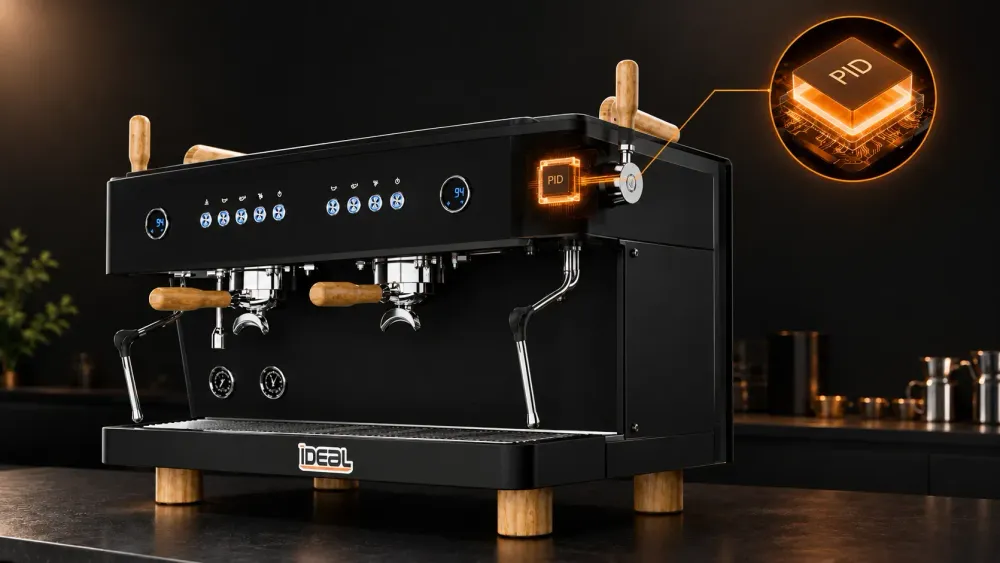
When buying a commercial espresso machine, you will often see terms such as PID, multi-boiler, pre-infusion and adjustable brew temperature.
But what exactly is PID—and does it really make a difference to your coffee?
The short answer is yes, particularly for specialty coffee.
What Is PID in an Espresso Machine?
PID stands for Proportional–Integral–Derivative controller.
In simple terms, a PID system helps an espresso machine control and maintain its brewing temperature more precisely.
Instead of allowing the boiler temperature to fluctuate significantly around a target point, PID continuously monitors temperature and adjusts the heating response to keep it closer to the desired setting.
For a barista, that means greater control and repeatability.
Why Does Temperature Matter So Much in Espresso?
Espresso extraction is highly sensitive to temperature.
Even when you use the same:
- Coffee beans
- Dose
- Grinder
- Grind setting
- Extraction time
changing the brewing temperature can change how the espresso tastes.
Temperature influences how different compounds are extracted from coffee.
Generally, a lower brewing temperature can reduce extraction, while a higher temperature can increase it. The ideal setting depends on factors such as roast profile, origin, processing method, dose and recipe.
This is why specialty coffee shops shouldn't necessarily be restricted to one fixed brewing temperature.
PID vs a Machine Without PID
A conventional thermostat or pressure-based heating system typically operates within a temperature range.
The heater switches on and off as required, which can create greater temperature variation.
A well-designed PID-controlled system can manage this process much more precisely.
For a busy café, this matters because the objective isn't simply to make one excellent espresso.
The objective is to make the first, fiftieth and hundredth espresso as consistently as possible.
But PID Alone Isn't Enough
This is extremely important.
Seeing “PID” on a specification sheet doesn't automatically make a machine suitable for specialty coffee.
You should look at the complete architecture of the espresso machine.
Ideally, start with a multi-boiler system.
A machine combining multi-boiler technology + PID control can provide much greater control because brewing and steaming requirements can be managed more independently.
For a specialty café, look for:
Multi-boiler architecture
PID temperature control
Stainless-steel boilers
Adjustable brewing temperature
Adjustable pre-infusion
Good temperature stability
Strong steam performance
The combination matters more than any single feature.
Why Adjustable Temperature + PID Is Even Better
There is an important difference between a machine simply having PID and giving the barista the ability to adjust the desired brewing temperature.
Suppose your café changes from a darker traditional espresso roast to a lighter specialty roast.
The extraction recipe that worked perfectly for the first coffee may not produce the best result with the second.
An adjustable PID-controlled machine gives the barista another variable to work with while dialing in the coffee.
This is particularly valuable for:
Specialty cafés, roasteries, competition-style coffee bars and cafés regularly changing their beans.
Ideal LaBella: Multi-Boiler + PID Control
This philosophy is incorporated into the Ideal LaBella commercial espresso machine.
LaBella combines a multi-boiler configuration with stainless-steel boilers, PID control and adjustable brewing parameters.
The machine allows greater control over important variables including:
- Brewing temperature
- Pre-infusion
- Steam pressure
- Water flow
For a commercial specialty café, this means the machine can be calibrated according to the coffee rather than forcing every coffee to work with one fixed setup.
Ideal E61 Elegante: Greater Control for Specialty Coffee
The Ideal E61 Elegante is another option for cafés looking for a more barista-focused espresso setup.
It combines E61 group technology with PID temperature management and adjustable brewing parameters, allowing baristas to fine-tune extraction according to their coffee.
This becomes particularly valuable for cafés working with different origins and roast profiles.
Do You Need PID in Your Café Espresso Machine?
For a basic setup with limited coffee variation, PID may not be the first feature you consider.
But if you're building a specialty coffee shop, temperature precision should be high on your checklist.
Before purchasing your next commercial espresso machine, don't simply ask:
“Does this machine have PID?”
Ask:
Is it multi-boiler?
Can I adjust the brewing temperature?
Does each brewing system have precise temperature management?
Can I adjust pre-infusion?
What material are the boilers made from?
Can the machine maintain consistency during continuous café operation?
Final Verdict
PID isn't just another technical term to put on an espresso machine specification sheet.
It is a tool that can give baristas better control over one of espresso's most important variables—temperature.
But for a serious specialty coffee setup, PID works best as part of a complete system.
Multi-Boiler + Stainless-Steel Boilers + PID + Adjustable Temperature + Adjustable Pre-Infusion
This is the combination café owners should look for when comparing commercial espresso machines.
Ideal Coffee Machines incorporates these technologies across machines such as LaBella and E61 Elegante, giving cafés greater control over extraction without assuming that a higher machine price automatically means better coffee.
Don't choose an espresso machine only by its brand name or price. Understand the technology inside it first.
Never Miss a Specialty Coffee Article
Google Preferred SourceAdd Ideal Coffee Machines as a preferred source on Google Search. Get prioritized access to commercial espresso machine comparisons, temperature profiling techniques, and barista workflows in Top Stories and AI Overviews.
What Causes Inconsistent Espresso Shots in a Café?
Grind, dose, temperature, pressure, pre-infusion, water and machine stability all shape espresso consistency — here's what causes ...
What Causes Inconsistent Espresso Shots A Complete Guide for Cafes
One espresso tastes perfect, while the next runs too fast, tastes sour, or produces a different volume. Inconsistent espresso shot...
The Rise of Specialty Coffee in India Why Multi Boiler Espresso Machines Are Becoming Essential
India's coffee culture is changing rapidly. Over the past decade, the country has witnessed a significant shift from traditional f...